Jackie Hamer is a huge fan of Christmas; and she believes the few things truly symbolize the spirit of the season ;like good, old-fashioned Black Cake.
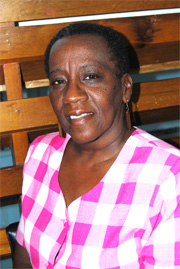
“The smell, the taste, the appearance of Black Cake, somehow, signals the advent of Christmas,” says the former Guyanese diplomat.
These days, her interest in this uniquely Caribbean Christmas offering has become an obsession and her current preoccupation is with seeking to carve out her own commercial niche to seek, she says, “to satisfy a demand that is probably greater than many people suspect.”
Working as a diplomat in North America she became familiar with the huge demand for Black Cake in the diaspora, “not only at Christmas but throughout the year.’
The commercial culture in North America is never slow to take advantage of demand for a product and according to Jackie she watched with fascination as what she had always regarded as a Christmas delicacy that was unique to Guyana become a huge industry. “I discovered, among other things that Black Cake is not unique to Guyana. It is a West Indian thing and there is a craving for it among West Indians in North America.”
During a recent interview with the Stabroek Business she brought along what can only be described as a well-researched dissertation on Black Cake. It is, as she puts it, “a descendant of the old-fashioned British Plum Pudding except that the contemporary generation uses rum, Caribbean rum to cater to the tastes of our own people.”
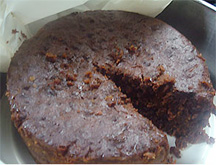
And while Black Cake has become with Christmas in the region Jackie says that her research has informed her that it is also a symbol of the British presence in the Caribbean, “The brown sugar, molasses and rum are reminders that it was the quest for sugar, and the slave labor that harvested it, that kept the British in the Caribbean, “Browning, also called burnt sugar essence, is sold in Caribbean markets, but it is easy to make,”
Jackie says the global popularity of Black Cake is more significant to creating a cohesive Caribbean culture than people susopect. “It has become a commonplace Christmas gift from relatives and friends in the Caribbean to Guyanese residing in the diaspora. True, its symbol of Christmas but there are people who have Black Cake in their homes all year round.”
Rum. She says, is “the very essence” of Black Cake. She explains that English cakes were soaked in alcohol to preserve them on sea voyages. “What was originally a preservative has now become the very essence of Black Cake,” she says.
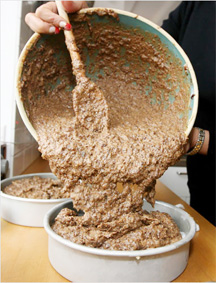
“This is not to say that the alcohol still does not serve its original purpose. What makes Black Cake interesting as a potential export product is the fact that it is sturdy, well-preserved and that it travels well.”
This Christmas Jackie has decided to place her skills to the test and to offer Black Cake to those Guyanese “who wish to add a touch of extra to their holidays.” She says that while she has actually sold a few Black Cakes “here and there” she wants to “do it bigger this time.”
And while she concedes that she is seeking to make this a genuine business venture she says that she is testing herself, testing her skills.
“I would consider it quite an achievement if I were to receive a few plaudits for my Black Cake. I have heard people boast about the quality of their cooking and I think that Black Cake is as good a thing as any to recommend one’s cooking.”
Beyond Christmas Jackie says that she is excited about the export potential of Black Cake. “What hampers effective marketing of our products is the underdevelopment of our packaging capacity. I have seen cake that is nowhere near as good as our own Black Cake sell well purely because of its superior packaging. We have to find ways of packaging things that say to people, buy me.”
Her preoccupation with packaging has led her to explore a range of options. “You can actually use different types of packaging depending on whether you are giving cake as a gift or displaying it for marketing purposes. There are also packages that lend themselves to having the cake travel long distances. One has to look at the various packaging scenarios.”
And while she still believes that BlacK Cake is part of the spirit of Christmas Jackie says that Black Cake probably has even greater potential. “I believe that there is room for developing both the local and global potential of Black Cake as a viable industry.
People are always willing to try something new and we must remember that there is already a ready and eager market in the diaspora.”