Toolbox

For the foreign service to fulfill its mission of promoting friendly relations, fostering conditions for economic development and protecting the country from adversaries it must find its way out of the wilderness of mediocrity and return to the path of professionalism.
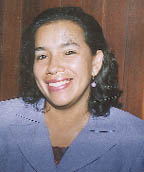
Minister  of Foreign Affairs  Carolyn Rodrigues

Minister of Foreign Affairs Carolyn Rodrigues

The recent appointment of Mr Harrinarine Nawbatt, a retired public servant and former minister, as ambassador to Brazil perpetuates the pattern that started nearly seventeen years ago. From its assumption of office in October 1992, the People’s Progressive Party-Civic administration’s attitude to the foreign service was clear. Appointments in the Ministry of Foreign Affairs would follow a path leading further away from professionalisation and towards increased politicisation.

The most distinguishing feature of that course of action has been the sudden and successful removal of several experienced diplomats and foreign service officers in 1992-93. Their only offence was to have been appointed by the previous People’s National Congress administration. As far as possible, they were replaced by PPP political appointees, remarkable exceptions being Mr Rudy Insanally and the now retired Marilyn Miles. Once political loyalty supplanted professional competence, however, the effects on the foreign service were predictable. Vacancies could not be filled easily by competent newcomers and the quality of foreign representation and internal research declined.

The diplomats
Guyanese know little of how their country’s foreign service functions. Basically, those functions may be summarised as representing Guyana through its foreign missions; reporting accurately on developments in the country of posting which are likely to influence the formulation of Guyana’s policies; protecting Guyana’s national interests; promoting friendly relations and extending consular facilities to foreigners and Guyanese nationals in the country of posting; and negotiating agreements on various issues with the authorities there.
For these tasks to be achieved, the representative of the state must adopt a ‘diplomatic identity.’ Arguably, such a process is essential for the international system today as states must interact with each other. The system requires exponents of the state‘s policies to be steeped in their nation’s culture and values. It is therefore desirable for ambassadors to be nationals who have lived, worked and studied in their home countries and to be educated or have experience in the practice of international relations and diplomacy.  For these reasons, émigrés, non-nationals and foreigners are always a poor substitute.
Focus on training

Focus on training

In a poor country such as Guyana, foreign missions are few and ambassadors are accredited to several states and international organisations simultaneously. Missions are small in size, qualified staff is in short supply and the tasks of representing the national interest are large. Hence, the foreign service must also be multi-lingual, multi-talented, multi-tasked and highly motivated.

The 1992-93 purge of the foreign service by the new Minister of Foreign Affairs Clement Rohee was easy to accomplish. That done, he had to face the difficult task of rebuilding a new service but there was a long period of indecision and inactivity. The administration seemed not to understand that an effective foreign service cannot be built overnight and, as in every serious professional field, competence comes more from higher education and long experience than from political enthusiasm. It also seemed not to have comprehended the crucial role diplomacy could play to advance the interests of a small state, especially one which was obliged to safeguard its immediate territorial integrity and, in the longer term, to emphasise its economic interests.
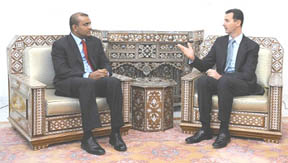
President Bharrat Jagdeo (left) in a meeting with Syrian President Bashar al-Assad (GINA photo)

President Bharrat Jagdeo (left) in a meeting with Syrian President Bashar al-Assad (GINA photo)

For several months after the purge was over, the new PPP/C administration failed to appoint new ambassadors to the three frontier capitals – Brasilia, Caracas and Paramaribo – and, for several years, there was no one to represent the country in Brussels, headquarters of the European Union. Of the five career foreign service officers left standing in charge of the missions overseas – Beijing, Havana, Brussels, Brasilia and the UN in New York – only two, Ivan Evelyn in Brasilia and Rudy Insanally, held the rank of ambassador.
Four of the earliest ambassadors to be appointed – Laleshwar Singh in London, Odeen Ishmael in Washington; Satyadeow Sawh in Caracas and Karshanjee Arjun in Paramaribo – were activists in the Association of Concerned Guyanese, an overseas-based branch of the PPP. They had not lived and worked in Guyana for several years and they certainly had no education or experience in diplomacy.  Mr Brindley   Benn, a former chairman of the PPP was appointed High Commissioner to Ottawa.

When the administration did move, it stumbled, controversially appointing Satyadeow Sawh as Ambassador to Caracas.  That did not go down well in the sophisticated Latin American chancelleries and galleries.  Mr Sawh soon had to be recalled to Georgetown where a special ministry was created for him and, in keeping with the practice of appointing prominent party members without diplomatic experience to ambassadorial positions, Bayney Karran replaced him.

The purge, inevitably, had triggered the unanticipated consequence of inducing feelings of fear and loathing even among those who were not immediately targetted.  When the career officer Ivan Evelyn, for example, was briefly appointed ambassador to Brasilia but was recalled to Georgetown after a few months, he quit the service. Made to feel unwanted and unwelcome, and without respect for their exertions or prospects for advancement, experienced and essential middle-ranking officers – a development economist; legal adviser; linguist; and a Caribbean and Latin American specialist among them – also started to leave. Several other officers at the missions in Brasilia, Caracas, London, Paramaribo and Washington, resigned. These departures forced major changes in organisation of responsibilities, but also        weakened, the Ministry.

Staff demoralisation became contagious and serious. Sidelining and firing officers, appointing untried, unqualified and mediocre persons to major positions, and reducing spending on the foreign service rattled the older staff. Repatriated officers became anxious over protracted delays in the payment of various overdue emoluments, outstanding promotions, and the perception that their careers may have hit a wall as a result of the administration’s decision to fill top-level diplomatic posts with non-career, political appointees.

Realising belatedly the grave  problems caused by the purge, the Ministry of Foreign Affairs adopted three stop-gap expedients. The first was a programme to retain or recall selected retirees – including persons such as Donald Abrams, Rudy Collins and Lloyd Searwar – in the hope of replenishing the pool of talent. The second was an attempt to recruit what was called a ‘fourth generation’ of foreign service officers, including a few from abroad who were employed under special contracts and paid super salaries. In so doing, however, the Minister of Foreign Affairs alienated several of his more experienced second and third generation officers who felt that their careers would be blocked. There was little need to worry, however, as many members of the so-called ‘fourth generation’ departed to pursue more satisfying careers  out of the country.

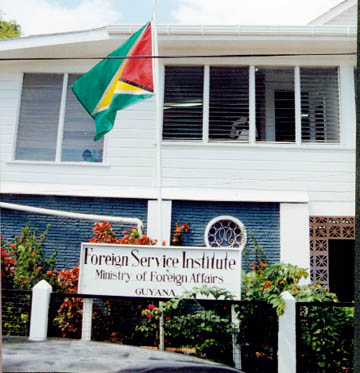
The third measure, laudably, was the establishment of the Foreign Service Institute which, properly managed and resourced, could have become an important asset in the ministry. But, after a promising start, the Institute became a victim of the same political mindset that poisoned every function in the ministry and that soon foundered.

The missions
Guyana’s choices of capitals as diplomatic missions have been influenced by the needs of securing its borders, developing its economy and interacting effectively with the    international community. Inevitably, the high cost of maintaining an effective diplomatic presence abroad has been a major limitation.

The presence of diplomatic missions in Brussels, London, Ottawa and Washington – four of the most valuable sources of economic assistance – and those in Brasilia, Caracas and Paramaribo – three continental neighbours, have the obvious advantage of favourable economic ties and maintaining close relations with frontier states. Those in Beijing, Havana and New Delhi – important enough during the Cold War and the heyday of the Non-Aligned Movement – remained consistent in providing assistance and scholarships in the areas of agriculture, industry, science and technology.

Today, only ten missions are occupied by diplomats of ambassadorial rank. Of these, seven are political appointees – Laleshwar Singh, London; Rajnarine Singh, Ottawa; Bayney Karran, Washington, DC; Odeen Ishmael, Caracas; Harrinarine Nawbatt, Brasilia; Karshanjee Arjun, Paramaribo; and Jairam Ronald Gajraj, New Delhi. Three others – Patrick Gomes, Brussels; Timothy Critchlow, Havana, and Rudy Insanally, United Nations, New York – can be considered professional.

The cost
The cost of sustaining even a sclerotic foreign service is high. The temptingly cheap solution of recruiting émigrés residing in their countries of posting and retaining diplomats at posts for periods in excess of a decade has eroded their effectiveness and reduced representation to a sham. Although this practice is due largely to the cost of reposting, it would be impossible to persuade diplomats who have served for several years in metropolitan countries to return to a country they and their families hardly know.

Thus, the quality of the foreign service has declined and this has been reflected in many missed or mangled opportunities and blunders, the most egregious examples of which occurred in 2000. In the first, the mission in Paramaribo seemed to have missed the signals of Suriname’s impending confrontation over the CGX petroleum exploration project off the Corentyne. Similarly, the mission in Caracas failed to warn Georgetown of Venezuela’s likely reaction to the Beal Aerospace Technologies project in the Essequibo. No comprehensive internal inquiry was instigated to investigate those diplomatic débâcles. These are but two of the more blatant examples of the political culture that is intolerant of self-examination, while resisting the rigour of external scrutiny.

The degree of dysfunctionality evinced by these disasters, nevertheless, made it clear that the Minister of Foreign Affairs had to go. Appointed in 2001, the new minister Rudy Insanally, cautiously commissioned a study of the ministry by the United Nations Monitoring Mission. Its report simply confirmed the extent to which eight years of maladministration had decimated a talented foreign service team, eviscerated the ministry and debilitated its performance for years thereafter. That report was an epitaph to a foreign service that was no longer capable of performing the functions for which it was established and that seemed to have  lost its way.



You can follow responses to this article through its RSS feed.

Subscribe to our electronic edition or get home delivery!


Reader Comments

  1. 110massive CANADA says:

    Can any explanation be given as to why European Based Staff are paid in US Dollars when they have to pay bills ,grocery etc in British Pound Sterling, and in some cases Euros.

    • UFO UNITED KINGDOM says:

      If i should put this way ‘CHEAP LABOUR IN HIGH PLACES’ because the us dollars is lower than the pounds and even euro.

  2. Frank Omar UNITED STATES says:

    Is this a serious article? It seems a joke to suggest that Guyana’s foreign missions should have warned the GOG about the CGX oil rig attack and/or VZ’s reaction to Beal. These are the functions of the foreign intelligence attache of any foreign mission – and as Guyana has no foreign intelligence service – it goes without saying that our foreign missions cannot and do not perform an intelligence gathering function, as the author apparently expects.

    The author clearly has an elementary, at best understanding, of how modern small country diplomacy works. The job of a modern small country diplomat is to lobby on behalf of his state – not to gather foreign intelligence. And so yes, someone familiar with the workings of the foreign government is probably best – not someone fresh out of Georgetown.

    And to claim the quality of the foreign service has declined? According to what measure? Because they failed to warned us about CGX? Did anyone warn us about Ankoko Island?

    Frank

    • REDDY IN BARBADOS BARBADOS says:

      Frank, aside from that valid criticism, I am still waiting for the editorial to define “professional”. Oh yes, the elderly , well schooled middle class gentlemen (or women) who in the
      main (there were exceptions) “professionally” apologised for the PNC dictatorship. That was the Ministry’s main role then. The Ministry was a travel agency for the PNC elite to travel. They had a big expenses account. I met a few of these professionals pompous mediocrities running around Barbados during the 1980s trying to get interviews with journalists.

      This fantasy about so called “Professionals” –there ain’t no such animal–doesn’t square with international reality. Which country these days doesn’t recall their Ambasadadors after another party wins an election ? Look at the situation in Barbados: after a different party wins in USA , the Ambassador is recalled.
      The editorial, aside from the poor logic, is lazily rehashing stale and indefensible arguments…

    • Georgie UNITED STATES says:

      Don’t worry Mr. Reddy. I peep your pedigree.

    • Griot UNITED STATES says:

      Aye NevvaReddy

      See this letter from one Norman Faria who apparently met Mrs. Jagan when he (Faria) was a “correspondent for the Mirror”.

      http://www.stabroeknews.com/2009/letters/03/30/mrs-jagan-worked-diligently-on-behalf-of-the-people/

      Now this likely highly partisan PPP Faria is apparently the Guyana Consul in Barbados. Lets try to work this out.

      Mirror Correspondent = Highly Partisan PPP Propandist = Exactly the kind of person that this article on the Foreign Service is talking about = Exactly NOT the kind of person that Guyanese of other ethnic/political persuasion are likely to get fair treatment from not to mention timeous processing of their passport renewal applications.

      Wha you tink bout da reddy?

    • Observer SWEDEN says:

      NeverReddy,
      Nobody on this site is surprised that you know Faria!

      Griot never said that political appointments equal discrimination and and ineffectiveness. Stop puttin words in de man mouth. He said “HIGHLY PARTISAN PPP PROGANDIST” you equate that to “political appointments”. You start wrong so your whole post based on your crude sleight of hand with the premise is x-amount of hot air.

      Methinks thou dost protest too much. Why don’t you and your alter ego Faria go get de lady passport reddy for she?

  3. Spin UNITED KINGDOM says:

    Do you know that there are places that one can change dollars to euros/pounds?

    Well I tell you! LOL…its true!

    • REDDY IN BARBADOS BARBADOS says:

      Griot, think. Does political appointments equal disrimination and ineffectiveness? If as you say it does, then you would have to fault to whole diplomatic appointee system worldwide. Essentially, when a new adminsitartion takes over you have the “party’s people” put in to ensure the government’s line is not sabotaged: this was clearly stated, for exmaple, in Barbados’ Prime Minister’s Thompson’s recent TV news conference. There ain’t no such animal as “professional”, “neutral” or whatever, though, as with everyhthing else the are exceptional cases.
      Your other illogical assertion is that such appointees will discrimnate. Those with attitude problems from the “good old days” may try to use this charge of the “discrimination” when they can’t get their way, when they can’t follow legitimate directives.
      I know Faria well, a working man.Didn’t he have a right to work as a correspondent for the Mirror ? Some of those so called “professionals”with their pompous medocrities deserved to be removed and replaced by persons rooted in everyday lives of people of all races and religions.Come again….

  4. Ingrid Khan UNITED KINGDOM says:

    When is my country going to recognise the offspring of Loyal Guyanese who were brought up and groomed in a political arena?

    These offspring grew up in an era where they were party to many changes from both PPP and the PNC, when family values were held in high regard. They were also fortunate to be well educated and most formed their own views and probably had visions of developing their country to bring it in line with the major world leaders, given the numerous amount of wealth Guyana holds, ie, Gold, Diamonds, oil, sugar, produce.

    Several of these young minds moved on and did their tour of duty within the political arena, and could have effectively represented Guyana in the missions named in your article. Instead, persons were appointed to the missions who only had vision for the status for themselves and not their country, hence several of the young loyalists ventured further afield to pursue and continue their own political development.

    As an example, I recall Mr Neville Bissember Jr who would have been, and in my opinion still is, the right candidate to effectively head the missions in London, Brussels, Canada or United States of America. Mr Bissember was overlooked on several occasions, WHY? Well, I am sure those who were party to obstructing him will be reading this article, and perhaps respond.

    Perhaps the present government should think of seeking these younger minds and accordingly placing them in an attempt to boost the dignity of their country, my country GUYANA.

  5. S.T.Persaud CANADA says:

    This is a contentious article that contains a serious flaw regarding the late Satyadeow Sawh. While there is little doubt that his appointment was met with mixed reviews, the insinuation that he had to be “quickly” recalled to Guyana for placement in a special ministry is utterly incorrect. If the author was more vigilant (and less focussed on trying to corroborate his provocative angle), he would have duly noted Mr. Sawh’s excellent work in Caracas over 3 years which earned him Venezuela’s second highest national award! As a former resident of Venezuela during Sawh’s tenure, the suggestion that he was not welcomed by the “sophisticated Latin American chancelleries and galleries” is an obvious misnomer, as Sawh’s record suggests. It seems beyond the author that Mr. Sawh’s exceptional performance could have earned him due recognition by the late Dr. Jagan and his party, which saw the need to recall such a man of action to serve the homeland. It’s a shame that due credit is not given to Sash Sawh for his work during a difficult time in Venezuela, even after his sad death.

  6. A. Persaud UNITED STATES says:

    I will have to agree with SN this time. The PPP has to grow up and realize it must not always be about politics only. It must be about our Guyanese people and our country first. It should also consider non political appointees who has the level of education and training.

    Having said that though, SN failed to mentioned that some of the PNC political appointees were trying to sabotage the democratically elected PPP government. And in many instances these appointees failed to carry out their obligations whilst the government had to fund their expenses.

    Hopefully the real functions of the FM can be carried out efficiently and effectively!

  7. r s. dasai UNITED STATES says:

    Frank, Reddy & ST. U know what is the deal.The article makes good reaing for the novice and shows the depth? of the writer’s knowledge of such matters. It attempts to create a mischief where none exists and complains about the lack of it.
    But how do you define ‘Professional’ in this sense? Let she who dances, pay the musician. Regards.

  8. Mohamed Z. Rahaman UNITED STATES says:

    I cannot speal for all the Ambassadors mentiones, but I know Ambassador Dr. Odeen Ishmael and teh article above does not do him justice.
    I met him on many occasions here in Washington DC and Maryland. While he was in Washington DC, he was a very effective Ambassador and his peers had the greatest respect for him. In fact, he put Guyana on the map so to speak. The Washington Diplomat magazine did a wonderful piece on him just a couple of months before he was transferred. It was no coincidence that he was a recipient of the Martin Luther King Legacy Award (previous winners includes former Pres. Jimmy Carter and Former Atlanta Mayor and UN Ambassador Andrew Young). From the OAS to the OIC, he was considered a top notch ambassador. Most importantly, Guyanese of all backgrounds found him to be a very humble and decent man. He opened the Embassy to all and I mean ALL!
    We were disappointed when he was transferred to Caracas and we are still unclear as to why. Our loss was Caracas’s gain. Today, even the Venezuelans refer to Dr. Odeen Ishmael’s writings when queried about the border dispute between the 2 countries. Such is their respect for the ambassador.
    To say that Dr. Odeen Ishmael is anything but professional is dead wrong.

    see the following website

    http://www.washdiplomat.com/02-03/a8_02_03.html

  9. jamar UNITED KINGDOM says:

    guyana diplomatic corp with few exceptions is pathetic. the article brought out some the narrow mindedness of political hawks.

  10. skinteeth UNITED STATES says:

    This article is so indicative of the political thinking in Guyana…”shallow” . It approaches the subject as if there was a nothing prior to 1992. As it is in all aspects of life in Guyana, we have to go back in time to understand and accept what transpired and try to find a way forward .This article fails miserably in this regard and as such offers nothing. We are either stuck with the those super salaried technocrats who bled the system under the PNC or we deal with the babbling Honorary Counsel like Faria in Barbados. We are between a rock and a very hard place.


Comments Page 1 of 212Next »

Leave a Reply

About Comments


The Comments section of this website is intended to provide a forum for reasoned and reasonable debate on the newspaper's content and is an extension of the newspaper and what it has become well known for over its history: accuracy, balance and fairness.

We reserve the right to edit/delete comments which contain attacks on other users, slander, coarse language and profanity, and gratuitous and incendiary references to race and ethnicity.

Curious about the little images next to each commenter's name ? Go here and sign up using the same email address you used to register for Stabroeknews.com then upload your image and confirm it.

More articles in Featured, Guyana Review