-‘interesting ideas’ for implementation agency
By Gaulbert Sutherland and Heppilena Ferguson
Hurdles to regional trade need to be tackled to ensure that exporting to Caricom is consistent with a single market and no different to similar activity within a country, Jamaica’s Prime Minister Bruce Golding says.
On the first full day of deliberations at the 30th summit of Caricom heads, he chided member states for being unable to come to such an agreement despite a commitment to do so, declaring that a lot of work needs to be done. The Prime Minster told reporters at the International Conference Centre yesterday that there is a need to establish a proper framework for standards.
He recalled that a commitment was made years ago to establish sanitary and phyto-sanitary standards that would be common to all countries. “We haven’t done that yet and we should get cracking on that. We also need to determine how are we going to deal with the question of certification. Under the WTO (World Trade Organisation) rules a country reserves the right to do risk assessments of (goods coming) into its country”, he stated.
“But we are a community, we are a single market and therefore we need to establish a framework of standards organisation where Jamaica would be prepared to accept the certification of the Trinidad standards body and vice versa rather than Jamaica having to say that before we need to accept the goods, we have to travel to Trinidad to go and inspect their processing facilities and they have to come to Jamaica to inspect ours”, he stated. Jamaica has experienced difficulties with its meat patties entering the Trinidad market and this led to Kingston’s Trade Minister Karl Samuda suggesting that a trade war was looming.
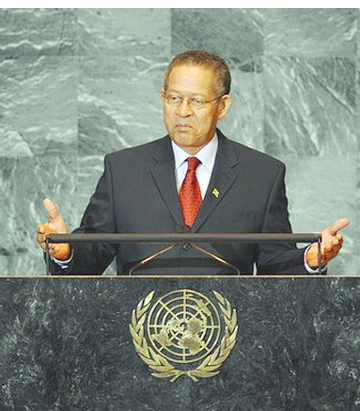
Golding declared that he finds it “ironic” and “absurd” that the European Union has accepted Jamaica’s standards organisation resulting in the grouping no longer needing to inspect Jamaica’s facilities. “They have assessed them and they accept their work and yet our own Caricom partners won’t accept the certification from our standards organisation, so is a lot of work that needs to be done”, he asserted.
He stated that this is important and portends significantly and adversely for the future, in that exporters are going to get tired of the frustration and therefore will not seek to build markets within the region. In this light, the Jamaican Prime Minister pointed out that there are exporters in his country, who feel that they can’t “bother with Caricom because it is too much headache” and are looking to North America, Brazil or Colombia to export. “They are prepared to pay duties in other markets rather than take on the burden of trying to get through the difficulties in Caricom”, he stated. Guyana has also experienced serious problems over the last decade with rice entering regional markets.
The Prime Minister commented that the hurdles need to be cleared away but it is not something that can be achieved through contention and quarrel. He said that the leaders must sit down and look at what needs to be straightened up, the commitments not honoured, the causes of the problem and how they can get this moving. Golding commented that he took this same view in relation to the free movement of Caribbean people – a hot button topic at this summit following a new Barbadian immigration policy that has seen Caricom illegals being rounded up and sent home under controversial circumstances.
Unilateral
Golding said he feels it is improper for any country in Caricom to take a unilateral position on the issue of intra-regional migration and use the issue of sovereignty as its defence.
In a direct reference to the migration policy adopted by Barbados, Golding told reporters that he was sure that heads could sit and work out any specific difficulties countries are experiencing with honouring any commitment under the revised Treaty of Chaguaramas.
“Let’s work them out. Let’s not go off each on our own frolic to take independent unilateral positions. A community cannot be run that way, we are all part of a community,” he urged.
Golding met with reporters during the lunch break of the first day of the summit which continues today.
The migration issue continues to be contentious following the implementation of a policy in Barbados which has since given rise to many allegations of Guyanese being ill-treated by immigration authorities there, some of them being subjected to raids on their homes in the wee hours of the morning and then once not in possession of the appropriate documentation, they are taken to the airport and asked to leave the island.
Many Jamaicans have also been the target of the policy which broadly intends to clamp down on illegal CARICOM nationals.
Golding told reporters that since his arrival here he made contact back home with his head of immigration to find out exactly how many CARICOM nationals have been refused admission to Jamaica for the year. He said he was informed that only three such persons were sent home, one who was on a security list and another had forged documentation. He could not remember the reason for the other person being sent home.
Golding said he then asked the official how many Jamaican nationals were refused admission to other CARICOM countries. “That figure was over 500,” Golding said.
He said he acknowledged that there were countries in the region that had problems with free movement which Jamaica does not have, particularly those with smaller populations.
But Golding said he felt there was no point in beating member states “with a hammer” into conformity and maintained that this was not the approach that should be taken. In this regard he pointed to a more practical approach.
Sit at the table
“We must sit at the table and if a country has a difficulty, discuss it with us, put in on the table because we have to be responsive to the particular difficulty that countries may have and we may need to work out with them. Maybe you can’t honour your commitment for the end of 2009, but how much more time you need and what special needs you may need,” he suggested.
He used The Bahamas as an example, noting that if that country had signed on to the CSME it would encounter migration issues because of its close proximity to Haiti. Golding said proximity to Haiti has also resulted in many Haitians migrating to Jamaica.
And even though this has been posing some problems for Jamaica in a number of areas, he said this has still not led to any denial of access to Haitians.
“But these are problems we must come to the table with. I don’t think it is proper for any us to take a unilateral position and talk about our sovereignty and our right to do what we consider to do in our national interest. We are part of a community and if we have difficulties honouring our commitments let’s talk about it,” he emphasized.
Free movement
commitment
Further Golding said he was hopeful that together all CARICOM Heads would come to some consensus on this very contentious issue since they were only six months away from a commitment made in 2007. That commitment was for there to be complete free movement of all CARICOM nationals by the end of this year.
Already, he said, he has instructed officials in Jamaica to be ready and not wait until December but to start fulfilling that obligation now so that there is no culture shock at yearend. He said CARICOM could be shaken by the issue but there was need for discussion on the matter.
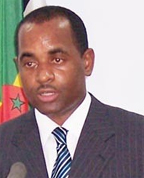
And while Dominican Prime Minister Roosevelt Skerrit prefers not to get involved in the debate, he cautioned that persons should be aware of the difference between free movement and domestic immigration policy. He also reminded reporters that while decisions were taken at the level of the heads, there was nothing in the revised treaty which gave responsibility for sanctioning of any member state.
“I will not engage in shouting across the Caribbean Sea. I don’t think it’s good for the advancement of the integration process. If there is an issue we have to discuss it and find a solution to the problem if there is one,” he urged.
He said he believed that there were domestic issues, of which migration was one, which countries have been working to address.
Against this background he urged against a “mixing up” of free movement with domestic immigration policy.
“Free movement does not mean that people can reside in another country illegally. We have to be careful we don’t mix the issues and then have this public fight among ourselves across the Caribbean Sea,” Skerrit said.
Managed Migration
Distinguished regional integrationist Sir Shridath Ramphal said yesterday he believes that there are genuine problems with migration in the region since it is not being managed and regulated.
“I don’t think there would be such a fuss if there had been an approach at the level of the heads about the management of migration,” he observed. Ramphal who feels strongly that political will was needed for there to be proper implementation of agreements made at the level of CARICOM, said too that a regional approach to the issue of immigration was a real challenge.
However he cautioned, “No one country should bear a disproportionate volume of the migration process and this is what has happened in Barbados… however I believe that what they are saying is that they want a managed migration programme and not no migration,” he said.
In an apparent reference to the targeting of illegal CARICOM nationals in Barbados, some of whom have been rounded up in early morning raids, Ramphal late last month told a gathering at the inauguration of the Caribbean Association of Judicial Officers in Port-of-Spain that it was sad that the Caribbean is experiencing a period when both policies and practices are deepening divisions and he cautioned that “we forget our oneness at our peril.”
He said too that it was always a sadness when, however propelled, “our societies are caught in a downward spiral of separateness with fellow West Indians cast as outsiders.”
Meanwhile, some “interesting ideas” have been discussed with regards to an implementation agency for decision making in Caricom, according to Golding. Poor implementation of decisions has been the bane of the community and was adverted to by former Prime Minister of Jamaica P J Patterson when he was decorated with the Order of the Caribbean Community on Thursday night.
Golding told reporters that he hopes that arising out of these ideas; a platform would have been built on which the Heads may be able to “finally address this enormous difficulty of governance”. He stated that he hopes that it gains traction because it makes sense to him and with regards to the “teeth” it may have, the Prime Minister stated that what is really needed is not so much teeth and authority but vigilance and this is the direction, they plan on going.
“I have been very clear and consistent on this. Caricom cannot acquire political authority without a political structure. We must stop tiptoeing around the mulberry bush”, he declared.
“If you want Caricom to be an authority that can override the Parliaments and the Cabinets of the individual member states then you must create a political union and identify those countries that are prepared to go in that direction. If you are not going in that direction, then the challenge is to find a mechanism that works because right now where the void I think exists, is that the authority resides in Heads”, he added.
Golding noted that Heads were prepared to give a commitment and having given that, to go home and persuade their cabinets and their parliaments. But, he pointed out, the Heads meet every six months and no organisation can operate on the basis that authority only exists twice a year for two or three days at a time.
“You need something that is more permanent or lasting and that’s where I think the decision has to (be made)”, he commented.