


Concluding critiques and recommendations on an NRF/SWF mechanism
Introduction Last week’s column asserted that, logically, any serious critique of Guyana’s Natural Resource Fund, NRF, ought to be pursued at two hierarchical levels of abstraction.
Introduction Last week’s column asserted that, logically, any serious critique of Guyana’s Natural Resource Fund, NRF, ought to be pursued at two hierarchical levels of abstraction.
Introduction In today’s column I wrap- up last week’s presentation dealing with the economic rationale behind the creation of a state-owned NRF or SWF to be used for effective regulation of the anticipated medium-term boom in oil revenues and the efficient spending of same revenues.
Today’s column starts my revisit of the Guyana Natural Resource Fund, NRF, alternatively termed Sovereign Wealth Fund, SWF.
Introduction Today’s column re-visits my original advisement on local content requirements.
Introduction OPEC It is not my purpose here and now to repeat the several earlier assessments of OPEC I have made since the start of this series on Guyana’s emerging oil and gas sector back in 2016, save and except to recall that OPEC is an inter-governmental body, which has declared its primary goal as the coordination and unification of its members’ petroleum policies.
Introduction Today’s column and next week’s will address the first of six broad strategic policy choices or actions that I propose the Authorities satisfy before the mid-2020s.
Introduction Following several comments and queries sent by readers I have come to the realization that, perhaps due to the length of the present series and complementing that, the irregularity of some readers of the columns, not surprisingly some of the readers have lost track of the sequence of the treatment on which I am presently proceeding.
Introduction Today’s column wraps-up my highlighting of the role of governance of Guyana’s emerging oil and gas sector as an indicator of its prevailing condition.
Introduction Today’s column begins with my wrap-up of last week’s column.
Introduction Today’s column has two aims. First, wrapping up my appraisal of the TIGI’s assertion that granting licences for 317 blocks, instead of 60 blocks, as the PSA requires, has had catastrophic domino consequences for Guyana’s emerging oil and gas sector.
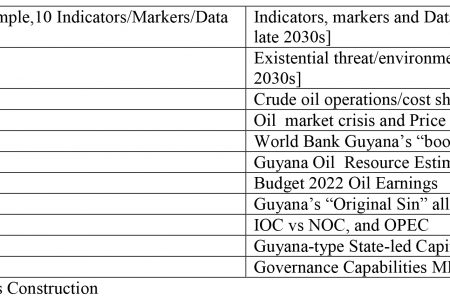
Introduction Thus far I have considered four of the ten sample indicators, which I had earlier advanced can provide an adequate profile of the present condition of Guyana’s emergent oil and gas sector: namely 1) existential threats, Venezuelan territorial aggression and environmental catastrophe; 2) modelled cost shares for crude oil production; 3) oil price projection; and 4) the World Bank’s call on Guyana’s boom cycle.
Introduction Today’s column presents brief commentary on three topics; namely, 1] the estimated break-even prices for Guyana’s crude 2] likely Brent crude oil price going forward, and 3] the World Bank’s prediction of a Guyana “boom cycle” going forward.
Introduction Today’s column continues the coverage of my linking of the theoretical analysis; that is Pillars A B completed so far and policy formulation for the sector, to come.
Introduction This week’s column and the ones immediately following are devoted to linking the two areas into which I have codified my presentation thus far.
Introduction Today’s column starts with a brief acknowledgement of my completion of the indicated “considered critique” of ExxonMobil’s performance in relation to global climate change and energy transition.
Introduction Today’s column addresses the fourth and final focus area for my critique of ExxonMobil’s actions in regard to the transition away from policies that reinforce global warming, climate change, and in support of primary reliance on clean energy technologies in an environmentally-friendly energy mix.
Introduction Today’s column addresses the second and third focus areas of my present critique of ExxonMobil.
Last week’s column represents an earnest effort on my part, to portray, largely in its own words, ExxonMobil’s official posture on global climate change and the energy transition away from fossil fuels usage.
Introduction In last week’s column, I had focused on those reputational risks which confront ExxonMobil, and are not risks directly arising from its performance in regard to global climate change and energy transition.
Introduction Today’s column brings together the manifest debt deformations of ExxonMobil [its zombification] on the one hand; and other deformations more directly related to the firm’s culture, its management performance, social and cultural interactions in the wider society, and consequently its reputational risk exposure.

The ePaper edition, on the Web & in stores for Android, iPhone & iPad.
Included free with your web subscription. Learn more.
