Hi Everyone,
If you’re from Guyana, Callaloo refers to all varieties of spinach (bhaji) but if you’re from Trinidad and Tobago, then Callaloo is the beloved, must-have, soul food dish of the twin island republic. Callaloo for Trinis is a concoction of dasheen leaves (aka eddo leaves), okra, crab and or salt meat, along with onions, pimento peppers (a mild pepper), hot pepper, green onions and thyme all cooked low and slow in a bath of fresh coconut milk.
In Trinidad and Tobago, a Sunday meal without Callaloo would leave your tummy filled but your soul empty. It accompanies the regular Sunday-meal dishes of macaroni pie, stewed chicken, potato salad, red beans and rice. All cuisines have dishes that are widely made with each household having its own recipe and method of preparation, Callaloo is no different.
Callaloo-making is a serious task, the arguments and discussions that go on about making this dish range from the preparation of ingredients to the texture of the Callaloo. Some say, chop and drop the ingredients others say, add everything whole. Some say to layer the ingredients, others say throw everything into the pot at once. And yet another hotly debated Callaloo-making issue is whether or not to swizzle the Callaloo. To swizzle means using a stick with a metal coil at its base, rolling it between the palms of your hands, all the while, pureeing the mixture. A dhal gutney (a stick that has a flat base that’s cut into the shape of a star) is often used if a handy swizzler is not nearby. The modern-day Callaloo maker can opt for the food processor using the pulse button to control the texture or an immersion blender. Apart from the swizzling, there’s also the question of whether Callaloo is a soup or a sauce. It can be either, it really depends on who is making it and for whom; some like their Callaloo watery, of a pouring consistency, while others like it thickened. Though traditionally prepared for Sunday meals, Callaloo is now prepared and available daily by many eating establishments.

The first time I had Callaloo was on my first trip to Trinidad when I was 11. I fell in love with it immediately and was content to just have that with the rice. So good! Many people like it served with dumplings, boiled ground provisions (tubular vegetables) or foo foo, especially plantain foo foo. Considered to be a peasant dish, Callaloo has its origins with the Africans who would have come to this part of the world during the colonial era. Today, it is enjoyed by all in the melting pot of culture and cuisine that is Trinidad and Tobago (T&T).
Whenever I visit T&T, the first thing I want to eat is Callaloo. This past week, a fish guy, (I told you about him in my column on the hassar (cascadura), had crab and I was lucky enough to find some dasheen leaves at the market, I was thrilled and excited to get home to try making Callaloo. Thanks to a Trini blogger friend and my trusted copy of The Multicultural Cuisine of Trinidad & Tobago and The Caribbean, I was able to come up with a recipe that would work for me. I cooked some rice and made a few dumplings and set them aside as I wanted to be able to eat my Callaloo as soon as it was done. I have to say, I was very pleased with my Callaloo, it was all I had hoped for, it was all that I remembered. My tasters still cannot stop talking about it. First, the aroma awakens your appetite and as you take a spoonful, it gently glides across your tongue as if caressing it; there’s no need to chew. The Callaloo blankets your taste buds hitting each spot with various notes. The dasheen leaves are creamy, the pink seeds of the okra pop gently, and the coconut milk is subtle and supportive being intertwined with all the ingredients. The flavour of the crab is enticing. If you happen upon a piece of salt meat, you smile as you bite into it and if you’re lucky enough to get the crab that has been cooked in the Callaloo, others would be envious.
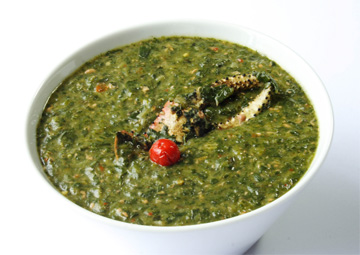
Other Caribbean islands have varying dishes using the same ingredients found in Callaloo. Take Dominica for example, they are well known for making a mean (read fantastic) Crab and Callaloo Soup. Theirs is clearly a soup and contains chunks of ground provision and actual pieces of crab along with salt meat. Here in Barbados, some households still make something called okra slush. Okra slush is made by boiling okra with finely cut up bits of salt meat along with fresh herbs. The okra melts completely and the dish is silky. It is eaten mostly with ground provisions.
So be on the alert, when you come to the Caribbean, be very clear on what it is you’re asking for in each country you visit whether it is Callaloo, Crab and Callaloo or bhaji (another word for spinach).
Cynthia
tasteslikehome@gmail.com
www.tasteslikehome.org