Page 1125...Last »

  • 0 Comments

    Dickens: One of the  greatest English writers

    Dickens: One of the greatest English writers

    Last week the world celebrated the 200th birthday of Charles Dickens who was born on February 7, 1812 in England.  Many events were organised by the BBC including the broadcast of 24 hours of readings from his work.  This was an hourly series of readings that went for the entire day at a different hour [...]

  • 0 Comments

    The NCC has lost sight of what a dress code is supposed to achieve

    The NCC has lost sight of what a dress code is supposed to achieve

    The imposition of dress codes has been a resurgent and irksome issue in Guyana in recent years, and on occasions there have been public complaints about the manner in which persons are denied entry to public buildings.  While there have been controversies when persons visit public offices generally, the matter has come into sharp focus [...]

  • 0 Comments

    The Romantic and the  Modern in a Hardy poem

    The Romantic and the Modern in a Hardy poem

    The Darking Thrush I leant upon a coppice gate When Frost was spectre-gray, And Winter’s dregs made desolate The weakening eye of day The tangled bine-stems scored the sky Like strings of broken lyres, And all mankind that haunted nigh Had sought their household fires. The land’s sharp features seemed to be The Century’s corpse [...]

  • 0 Comments

    The return of performing arts awards

    The return of performing arts awards

    In January 2011 The Theatre Guild of Guyana presented awards to the best performances that were staged at the Guild Playhouse during the year 2010.  This was the revival of an old tradition that had faded into disuse but has now been recalled to life.  It has so far continued in this new re-establishment, and [...]

  • 0 Comments

    What is calypso?

    What is calypso?

    What is calypso?  Many have attempted to answer that question, including a few calypsonians.  These versions vary from fanciful explanations about how it came from Africa or France to scholarly background and historical studies of how it evolved in the Caribbean from the times of slavery. The legendary and undisputed king of calypso, The Mighty [...]

  • 0 Comments

    The most vibrant masquerade tradition in the Caribbean

    The most vibrant masquerade tradition in the Caribbean

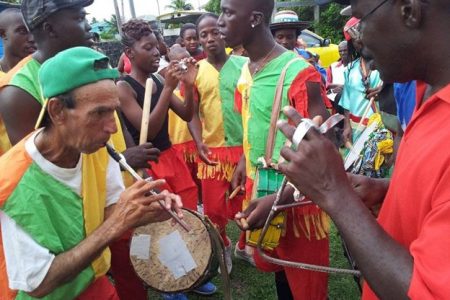
    The Trinidad Carnival is often called “the greatest show on earth” even though the Rio Carnival in Brazil might have claim to that title.  But game and worthy challenge might come from smaller, less known quarters, viz the junkanoo festival in the Bahamas. We have already mentioned in these pages that there are Christmas-time traditions [...]

  • 0 Comments

    Should auld acquaintance be forgot, and never brought to mind?  Should auld acquaintance be forgot, and auld lang syne?    Chorus :  For auld lang syne, my jo, for auld lang syne  We’ll tak a cup o’ kindness yet, for auld lang syne.   And surely ye’ll be your pint-stowp! and surely I’ll be mine!  And we’ll tak a cup o’ kindness yet, for auld lang syne.   We twa hae run about the braes, and pu’d the gowans fine;  But we’ve wander’d mony a weary fit, sin auld lang syne   We twa haed paidl’d I’ the burn, frae morning sun till dine;  But seas between us braid hae roar’d sin auld lang syne.   And there’s a hand my trusty fiere ! And gie’s a hand o’ thine!  And we’ll tak a right gude-willy waught for auld lang syne.    Various versions of those words would have resounded all across the world last night, since the song Auld Lang Syne by Robert Burns has become the international anthem for the New Year and is sung or played everywhere on the stroke of twelve on Old Year’s Night.  But how did a mere light-hearted poem in praise of drink achieve such prominence as the most celebrated and popular verse of its kind in the world?  There is more to it than that.  Last year we discussed poems for the New Year and observed that the more enduring “new year” poems were those that did not merely proclaim the seasonal event, but had some greater depth and profundity; those whose authors used them to make further statements about various issues.  Some examples of these great new year poems are Thomas Hardy’s The Darkling Thrush, Alfred Lord Tennyson’s In Memoriam and Auld Lang Syne by Burns.  Some Caribbean poets are also known for producing poems of that ilk, namely, Derek Walcott, Cecil Grey and Mark McWatt.  Burns is known for his delight in frivolous songs in praise of drink, of which Auld Lang Syne is one, sometimes revelling in ‘profanity’ to mock censorious critics, the clergy and authority.  So how did he and his song find themselves in such illustrious company?  Robert Burns (1759-1796) published several folk songs and bawdy lyrics about carousing, sexuality and drinking, which he himself described as “the simple and the wild.” These include Coming Through The Rye, about a sexual encounter in the field of rye, which has a ‘printable’ and an ‘uncensored’ version (found in Wikipedia) with explicit words to shock and react to his critics.  John Barleycorn: A Ballad  (1782) is a tribute to whisky based on an old folk song and tells of the Three Wise Men bringing the gift of whisky to mankind.  Scotch Drink (1786) is an ode to scotch whisky, the poet’s muse, and Lady Onlie Honest Lucky (1787) is one of countless folk drinking verses.    Poems of this nature are found even among his more serious work. “Tam o’ Shanter” (1792), for example, is a humorous ‘heroic’ satirical commentary about drinking which also takes a dig at the church, but it includes dangers and horrors, a touch of folklore and a warning against excessive drink.     His core of strong poetic work is by no means voluminous for a major national poet, and his achievements in this regard are relatively limited.  But Burns is very highly regarded among British writers; he is the greatest Scottish poet, the National Poet of Scotland where he is known as ‘The Bard’; is described by literary critic David Daiches as “the greatest song writer that Britain has produced”; is extremely popular and influential worldwide, including in Russia; and is commemorated in statues and monuments in several countries including the UK, Canada and the USA.  He worked as a farmer and a ploughman for most of his life before the rapid success of his published poetry shifted his focus.  To what does he owe this extraordinary reputation?  First, to the quality of his verses; to cite a few of his best known and most acclaimed poems, To A Mouse (1785), A Red Red Rose (1794), Scots Wha Hae (1793), The Battle of Sheramuir, Tam o’Shanter and Auld Lang Syne contain examples of this quality in some memorable lines, depth of meaning, profound imagery, neatness of metre and structure.  These lines have influenced and inspired other writers.  American John Steinbeck’s novel Of Mice And Men (1937) took its title from the lines “The best laid schemes o’ mice an’ men / Gang aft agley.”  This is a well-known idiomatic saying, now common in the English language and rendered as “the best laid plans of mice and men go oft astray.”  JD Salinger in ironic fashion used Coming Through the Rye for the title of the novel The Catcher in the Rye (1951), and Bob Dylan acknowledges A Red Red Rose as his greatest inspiration.     Burns was a radical whose poetry strongly appealed to republicanism and Scottish nationalism.  His Scots Wha Hae was adopted by Scotland as an unofficial national anthem (Wikipedia) and he was so influential in English literature that he is regarded as having ushered in Romantic poetry before it was ‘officially’ founded in 1798.  This is a credit he shares with William Blake.  This arises from his radical thought, poetic biases, and from another of his greatest contributions to poetry, that is, his determination to write in Scottish dialect which gave power to his “simple” verses and is among his major achievements. This is linked to his dedication to researching, collecting and recording Scottish folk songs, which helped to preserve them and add to his own poetry and songs in the native language.  Auld Lang Syne is one of the poems that came out of that very old tradition of verses glorifying drink (the tradition is centuries older than Burns) and the valuable corpus of traditional oral verses of Scotland. It has also become Burns’ single most popular contribution to the world.  It is itself a tradition linked to Hogmanay (Old Year’s Night) in Scotland and quickly adopted by the whole of the UK along with a ritual of holding hands in a circle which also spread around the world where the English language went.  But Wikipedia provides an amazing list of non-English speaking countries and customs where the song features.   Neither is it a mere trivial drinking chorus.  It is among the great New Year’s poems that transcend seasonal reference and has depth of meaning as a poem. The lines are often loosely translated from the Scots resulting in inaccurate words and misunderstanding of what it really means.  A most common misinterpretation is that it is about forgetting the old and bringing in the new, but that is almost the opposite of Burns’ main statement.  Burns took it from one of the several pieces of oral literature that he collected in rural Scotland, and it resembles an earlier ballad by James Watson Old Long Syne printed in 1711.  But a comparison of the words show that Burns’ version is more than a transcription and most of it is his own creation.  It also shows the greater weight of meaning crafted by the poet.  Firstly, Watson’s 1711 recording is a love song addressed to “my jo” (my love/my dear).  Burns makes it not a complaint about a forgotten love, but a message to mankind.  He uses the base of the speaker addressing an old acquaintance, who could have been his love, but broadening the sentiments to a more universal reference point.  It stresses that times past, old acquaintances and experiences should not be forgotten.  The title “auld lang syne” means “old long ago” (literally “old long since”).  The opening lines are rhetorical questions and the poem focuses on the value of friendship.   The imagery is consistently tight-fitting.  Stanza three refers to time spent by “we twa” (we two) together running about the fields and flowers in the local surroundings, contrasting that with longer distances and weary journeys that have come between them since.  Stanza four then refers to them playing about in streams, contrasting that with not expanses of land this time, but “broad seas” that “have roared” between them.  While small streams kept them together, the distance separating them is now measured by vast bodies of water.  So why is it a drinking song or verses in praise of drink?  And if it is, what makes it superior to the other “simple and wild” ones?  It is indeed simple, but deep.  Stanza two says “you’ll buy your pint-stowp” and “I’ll buy mine,” while the final stanza mentions taking “a right gud-willy waught” (a good-will draught) which are all references to “a pint” or a drink in the pub.  But note that the drink is proposed as a symbol of friendship and good will.  It is taken as a ritual or libation to honour the memory of “old long ago” when there was bonding.  What is very important is taking “a cup of kindness” proposed in the chorus.  The drink metaphorically becomes kindness of which it is symbolic, and it now takes on the proportion of something which contains the goodness of mankind.  In addition, there is Burns’ radical proletarianism.  This reunion seems set in a public house, a pub, a tavern or ale house where people will meet for “a pint,” not a castle, a grange, a manor or other upper or middle class dwelling.  It is against this kind of setting that they extend a hand to each other of universal friendship.    The New Year then becomes a renewal and a re-establishment of “kindness” and communion values.  Mankind is reminded of the importance of remembering old friendships and bonds “for auld lang syne.”  That is what Burns has given to the world.

    Burns and the New Year anthem

    Should auld acquaintance be forgot, and never brought to mind? Should auld acquaintance be forgot, and auld lang syne? Chorus :  For auld lang syne, my jo, for auld lang syne We’ll tak a cup o’ kindness yet, for auld lang syne. And surely ye’ll be your pint-stowp! and surely I’ll be mine! And we’ll [...]

  • 0 Comments

    Christmas: A religious and secular festival

    Christmas: A religious and secular festival

    Christmas is a religious festival, but it is much more than that.  It is Christian, and is one of those typical religious festivals that are expressions of belief with internal sacred rituals and worship, but which also have a large public outreach.   Again, like so many other religious festivals, the public celebration is primarily utilised [...]

  • 0 Comments

    A poet of the Harlem Renaissance

    A poet of the Harlem Renaissance

    When old age shall this generation waste, Thou shalt remain, in midst of other woe Than ours, a friend to man, to whom thou sayst, “Beauty is truth, truth beauty,” – that is all Ye know on earth, and all ye need to know. (John Keats, from ‘Ode On A Grecian Urn’) The Harlem Renaissance [...]

  • 0 Comments

    Goddison’s poems of heritage and history

    Goddison’s poems of heritage and history

    As mentioned in a previous discussion, there is no shortage of celebrated verses to mark the United Nations designated International Year of People of African Descent (IYPAD) in 2011.  The most appropriate place to start is with the oral traditions within which several African poetic continuities, African derivations or the African influence may be found [...]

  • 0 Comments

    Where are the differences?

    Where are the differences?

    There is a great irony in Guyana in the way one of its greatest unifying forces has been characterized as a force of division.  A real cultural strength possessed by the nation has been a factor in the rancour.  Guyana prides itself in noble words on being a multi-ethnic, multi-cultural nation of “six races,” but [...]

  • 0 Comments

    Claude McKay (Internet photo)

    McKay: A special contribution to poetry

    If We Must Die If we must die, let it not be like hogs Hunted and penned in an inglorious spot, While round us bark the mad and hungry dogs, Marking their mock at our accursed lot. If we must die, O let us nobly die, So that our precious blood may not be shed [...]

  • 0 Comments

    A return of the old traditions

    A return of the old traditions

    The very popular Jamaican play Ghett-Out has proved itself to be a work of limited dramatic achievements.  But it represents considerable achievement in the context of the forward march of commercial theatre. Developments in cultural industries in the Caribbean are extremely wide-ranging and really very interesting.  The important question was asked in the Carifesta Symposia [...]

  • 0 Comments

    The 32nd season

    The 32nd season

    Guyana’s National Dance Company (NDC) performed its Season 32 on October 22 – 23, 2011 on the theme Hello Darkness.  The production, directed by NDC producer and choreographer Vivienne Daniel, with narration by hostess Shevonne Semple, focused on the theme of darkness in the first half with the second segment devoted to two tributes: one [...]

  • 0 Comments

    Ramlila and Diwali:  ritual, spectacle and cultural impact

    Ramlila and Diwali: ritual, spectacle and cultural impact

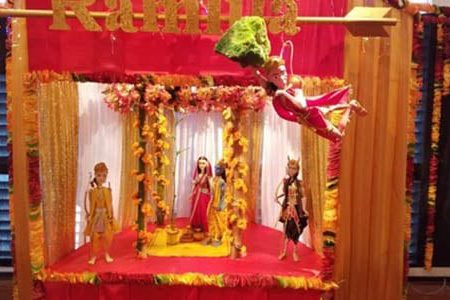
    Two related Caribbean festivals are again topical at this time of the year. It is the season of Diwali, one of the largest traditional festivals in both Guyana and Trinidad and Tobago. The annual Ramlila performances ended in Trinidad on Sunday, October 9, and Diwali will be celebrated in both countries on October 26. These [...]

Page 1125...Last »