The diversification programme includes alternative crops, and livestock as well as aquaculture.
“Within the ambit of this project we are mulling types of legislation, institutional frameworks, policies and we have engaged a consultancy firm to guide in the interventions we need to make and to provide technical assistance,” Persaud is quoted as saying by the Government Information Agency (GINA) in a news release.
Persaud was speaking on the Agriculture Export Diversification Programme at the National Meeting for Livestock Farmers held by the Guyana School of Agriculture at Mon Repos, East Coast Demerara.
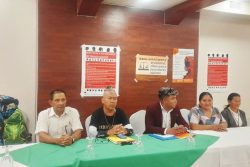
The forum was held to discuss with cattle farmers the various measures being adopted to expand the beef industry under the Agriculture Export Diversification Programme.
The minister noted that Guyana has tremendous capacity for taking care of its domestic needs while becoming a lead exporter in beef and at the same time satisfying its demands for quality.
Persaud has acknowledged that there is no coherent institution which can coordinate the crucial aspects of the livestock industry since this is currently fragmented under different agencies.
However, he disclosed that a Bill has been passed in Parliament which will allow for the establishment of a Guyana Livestock Development Authority to adequately guide and manage the sector.
The project will also see the construction of a veterinary laboratory at Mon Repos that will facilitate conducting tests and implementation of a robust animal health surveillance systems.
In the meantime, consultants have determined that Guyana’s herd size, of about 280,000 head, is not sufficient to support additional export as well as local demand.
Persaud said that in an effort to support farmers, government is investing $400 million to assist in herd expansion, pasture preparation and improve genetic stock.
And to accommodate the increase in the cattle population, the ministry is also looking for additional land all across the country.
The minister said discussions are ongoing to acquire land in the intermediate savannahs, the left bank of the Abary River, 7,000 acres in Berbice for repossession and vast areas in Region Nine that have been lying idle.
$206M abattoir coming
Meanwhile, government is discussing the construction a state-of-the-art abattoir where cattle can be prepared, in accordance with health safety regulations, for both local and overseas markets, Persaud disclosed. The minister said the construction of the abattoir is expected to cost $206 million and although Region Five was suggested, the location of the facility is still to be determined, the release stated.
He said government is considering having the abattoir built through a public/private partnership agreement.
Persaud said all cattle preparation facilities must be up to standard if local farmers are to export beef on a large scale. Persaud hinted that he is looking at Brazil as a possible source of foreign investment in this area, GINA said.
Nigel Cumberbatch, Senior Research Scientist at the National Agricultural Research Institute, said the beef sector is noted for its self-sufficiency since Guyana has never had to import beef during peak seasons. He said Region Nine had once been the main exporter of beef in the 1960s to neighbouring Brazil.
Cumberbatch, who will now manage the agri business cluster, explained that the hospitality and hotel industries have recently been importing specialty cuts. “So we are now in the process of reviving the cattle industry to improve and expand beef production,” he said, adding that a revitalised beef industry would be a major foreign exchange earner since there is definitely a market for beef and beef products.
Meanwhile, Project Coordinator of the Agri Sector Diversification Unit, Sattie Sasenarine remarked that the programme will contribute to Guyana’s export growth rate and reduce the volatility attached to a dual-crop economy.
She said farmers will be trained and given the technical assistance to develop their business along the commodity value chain.
Focus will be placed on health and food safety services as well as drainage and irrigation rehabilitation in the Canals Polder, Region Three.